
All Sensex components ended in the red. IndusInd Bank was the top loser, followed by Tata Steel, HDFC, ICICI Bank, Axis Bank, Infosys and ITC. According to traders, volatility heightened in global markets as US Federal Reserve's interest rate cut stoked concerns over an impending economic recession.

Top losers in the Sensex pack included IndusInd Bank, Yes Bank, SBI, L&T, Tata Steel, M&M, Bajaj Finance, Vedanta, Tata Motors and RIL, tumbling up to 6.97 per cent.

Wipro, India's third largest information technology (IT) services company, is expected to continue with its strong show during the October-December quarter of financial year 2014.

As markets complete the first half of the calendar year 2022 (CY22) with a fall of around 9 per cent, the interest-rate hike trajectory by global central banks, paired with the conundrum of inflation and growth, will move the needle for the market, observe experts. Here's a quick rundown on what they'll react to over the next six months.

ICICI Bank was the top laggard in the Sensex pack, cracking over 5 per cent, followed by Kotak Bank, HUL, HDFC, IndusInd Bank, HDFC Bank and Nestle India. On the other hand, Hero MotoCorp, Bajaj Auto, Maruti, TCS and HCL Tech were among the gainers.

Yes Bank topped the gainers' list on the Sensex. It was followed by HDFC, Bajaj Finance, HDFC Bank, ICICI Bank, L&T, SBI, Axis Bank and Kotak Bank -- rallying up to 5.24 per cent.

Stock market investors are expecting a balanced Budget with a focus on job creation, increased spending on infrastructure, reigning in the deficit, and bringing the economy back on track, experts said on Wednesday. Stock markets have been subdued in the run-up to the Union Budget with BSE's benchmark Sensex is almost flat so far this month. Even the corporate earning season failed to excite the markets, while some indices like IT and bankex have seen some positive movements.

Mahindra and Mahindra was the top gainer in the Sensex pack, surging over 16 per cent, followed by Maruti, Titan, Bajaj Finance, HDFC, Bajaj Auto and Hero MotoCorp. On the other hand, HUL, Tech Mahindra, IndusInd Bank and Nestle were the laggards.

Dollar's strength against some currencies overseas and firming crude oil prices also put pressure on the rupee, dealers said.

Stock market barometers Sensex and Nifty ended marginally higher on Monday as rise in wholesale inflation capped early gains despite a positive trend in global markets. The 30-share index settled 32.02 points or 0.05 per cent higher at 60,718.71 with half of its constituents ending in green. The broad based Nifty edged up 6.70 points or 0.04 per cent to close at 18,109.45.

Data compiled by National Collateral Management Services (NCML, a non-government body) shows a 6.3 per cent rise to 109 million tonnes (mt). The Union ministry of agriculture's first advance estimate was 100.5 mt, as compared to 102 mt in last year's fourth advance estimate.
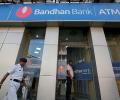
It is 10 years since Bandhan Financial Services became the first microfinance institution (MFI) to receive the universal bank licence. A year later, in 2015, it started operations. Bandhan's entry into banking was seen as a vote of confidence by the Reserve Bank of India (RBI) for the country's microfinance sector. Subsequently, the RBI awarded small finance bank licences to nine MFIs.

Jhunjhunwala holds a stake in more than 30 listed firms.

IndusInd Bank was the top laggard in the Sensex pack, cracking around 10 per cent, followed by HDFC, Maruti Suzuki, Axis Bank and UltraTech Cement. On the other hand, TCS, Infosys, ITC and HCL Tech closed with gains. NSE Nifty plunged 313.60 points or 3.43 per cent to 8,823.25.

"Patel's resignation will shake foreign and domestic trust in the RBI's autonomy and shows that a red line has been crossed."

Top laggards in the Sensex pack included HDFC, ICICI Bank, TCS, HCL Tech, Kotak Bank, Asian Paints, TechM and HUL, dropping up to 2.67 per cent.

Sebi on April 4 gave the brokerages 60 days to have their books vetted by third-party auditors.

Top gainers in the Sensex pack included Yes Bank, TechM, Bajaj Finance, Bharti Airtel, Maruti, Asian Paints and Hero MotoCorp - rising up to 5.30 per cent. The 50-share Nifty ended 85.65 points, or 0.79 per cent, higher at 10,948.25 points.

Bajaj Finance was the top loser in the Sensex pack, tanking over 10 per cent, followed by Axis Bank, Maruti, M&M, Tech Mahindra and ONGC. The gainers included ITC, Bharti Airtel, Kotak Bank and Hero MotoCorp.
Finance Minister Arun Jaitley said Sebi would develop new products in the commodity derivatives space apart from taking steps to deepen the corporate bond market.
Forex dealers said besides robust month-end demand for the American currency from oil importers, dollar's strength against its rival currencies on expectations of rising interest rates amid lingering Sino-US trade tensions, weighed on the domestic currency.
Asian shares have begun the week on a plaintive note.
the broader NSE Nifty settled 114.90 points, or 0.96 per cent, higher at 12,086.70. Axis Bank was the top gainer in the Sensex pack, rallying 4.21 per cent, followed by Vedanta 3.75 per cent, SBI 3.39 per cent, Maruti 3.20 per cent, IndusInd Bank 3.07 per cent and Yes Bank 2.87 per cent. Bharti Airtel slipped 1.98 per cent, Kotak Bank 1.38 per cent, Bajaj Auto 0.88 per cent, Asian Paints 0.31 per cent, HDFC Bank 0.05 per cent and HUL 0.03 per cent.
Tech Mahindra was the top laggard in the Sensex pack, cracking over 5 per cent, followed by Infosys, HDFC, IndusInd Bank, Reliance Industries and NTPC. On the other hand, Hero MotoCorp, L&T, Maruti, UltraTech Cement and Sun Pharma led the gainers' chart.
ICICI Bank was the top laggard in the Sensex pack, sinking over 10 per cent, followed by Bajaj Finance, HDFC, IndusInd Bank, Axis Bank and Maruti. Bharti Airtel and Sun Pharma were the gainers in the BSE index. NSE Nifty suffered a heavy loss of 566.40 points, or 5.74 per cent, to settle at 9,293.50.

'You should always maintain an allocation to gold as it has the ability to counterbalance any correction in the equity market.'

Though there have been no cancellations of contracts by invoking the force majeure clause, a number of clients - especially in the worst-affected sectors like travel and hospitality, oil and gas, as well as manufacturing - have started asking for reducing level of IT support.

Since the Union Budget, gold has become costlier by 8-9 per cent because of a 2.5 per cent increase in import duty to 12.5 per cent and about a 5 per cent depreciation in the rupee.
Reliance Industries was the top gainer in the Sensex pack, rallying up to 15 per cent, followed by Kotak Bank, Maruti, HDFC twins, Titan, L&T and Axis Bank. On the other hand, IndusInd Bank, ONGC, ITC and Bajaj Auto closed with losses. the NSE Nifty settled 516.80 points, or 6.62 per cent, up at 8,317.85.

'The minimum holding period for equities should be three years.' 'Try goal-based investing.' 'Link your equity portfolios to specific goals such as retirement, purchase of a house or car...'
All Sensex components ended in the red. SBI was the top loser, followed by ONGC, Axis Bank, ITC, Titan, Bajaj Auto, TCS and IndusInd Bank.
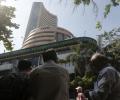
The broader NSE Nifty, on the other hand, ended 2.70 points, or 0.02 per cent, lower at 11,555.90 in its third straight day of losses.

'Bell Bottom may not have collected what was expected, but it has done a great service to the industry by reopening hundreds of cinema halls.'

'Stick to FDs of shorter tenures, preferably one-two years.'
Financial services firm AnandRathi analysed the key points of the policy soon after it was announced.

Short sellers may capitalise on the weak sentiment owing to the dispute between co-founders Rana Kapoor and Madhu Kapur.

Else, more capital outflow and pressure on rupee likely.

In the mid-tier space, clients with weak balance sheets are likely to ask for price revision apart from delay in payment.
The news that exports to the US will not restart before next year as well as the September quarter performance are sentiment dampeners.

Corporate margins and profits in India remain vulnerable to changes in crude oil prices in the international market. Historical quarterly data from listed companies (excluding banks, finance and insurance, oil and gas, and power sectors) indicate an adverse correlation between corporate margins and crude oil prices.
